A murmuration is a flight of birds moving as a single body. I recreate it with thousands of origami cranes, born of the traditional Japanese art of paper folding.
After art school, I spent more than seven years as Kenzo Takada's creative assistant, in his Paris studio. One day, he took his team to Burma, to Bagan, the plain where more than two thousand temples rise.
We set off at dawn to fly over the plain in a hot-air balloon. As the sun rose, each temple cast a long shadow on the ground, and hundreds of silhouettes lay down in the same direction. It was there, above Bagan, that the idea was born: simple forms, repeated by the thousand, and light to give them a shadow.
Each bird is folded, resined, then painted by hand. A small piece takes three to four weeks of work, large formats far longer: thousands of repeated gestures, until the flock comes to life.
The composition is read in space. The flock lifts away from the wall in a curve, not a straight line, and a few birds break away here and there, as in a real flight.
Then comes the light. Depending on the place, one or several lights cross their beams: each crane casts one or more shadows, and the work multiplies across the wall. Depending on the angle and the viewer, you see more of the birds or more of their shadows.
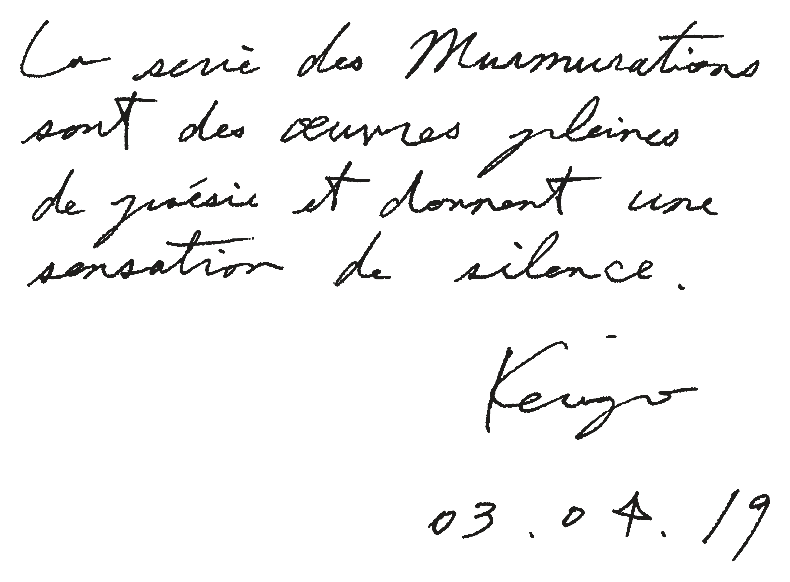
I live and work in the Ardèche, in the south of France, in a studio surrounded by forest, far from the noise. A place suited to the silence Kenzo Takada saw in the Murmurations.